Audio Crew

Serving the Greater Moncton Area and All of New Brunswick

624 Salisbury Rd, Moncton, NB E1E 1B8, Canada 506-858-2739
  • Home
  • Services
    • Car Audio
    • Marine Audio
    • Motorcycle Audio
    • Remote Starters
    • UTV and Side-by-Side Upgrades
  • About Us
  • Location
  • Contact Us
  • Facebook
  • Instagram

Car Starter Remote Control Options

Starter RemoteIt’s fall, and for the mobile electronics industry, the focus shifts directly to the sales and installation of remote car starters. The size of the remote start industry is inconceivably vast. Some retailers sell and install more than a thousand of these handy little gadgets in a single season! Best Car Audio wants to help you make the purchasing process easier. Here is our introduction to remote car starter remote control options.

What Does the Remote Do?

The remote control provided with your car starter allows you to start your vehicle without having to go outside or put your key in the ignition. The philosophy is that on a cold winter morning or scorching hot summer day, you can start your vehicle a few minutes before you go outside, giving the heating or cooling system a head start on making the vehicle more comfortable.

Starter Remote
Remote range is affected by a number of things

Remote controls communicate with your vehicle using radio frequency transmission. There are two different types of communication – Amplitude Modulation (AM) and Frequency Modulation (FM). The methodology of communication alone does not determine the performance of the remote regarding range, and range is a key point in choosing a remote control. Range is the distance between you and your vehicle when the remote starter will execute commands from the remote. If you are out of range and you press the Start button on your remote, nothing happens.

Typical Range Performance

Last year, we tested a few systems that claimed to offer one-mile range. We installed both systems in the same vehicle, one after the other. We parked the vehicle in the same location to test each system. Both systems offered performance that was nearly identical and worked reliably up to about 1,600 feet away – not close to a mile. We contacted some industry peers about the performance of other systems. We saw a test of another brand, rated to provide 1 mile of range and capable of starting the vehicle from as far as 1.25 miles away. As expected, the performance of your system may vary dramatically.

Why didn’t the systems we tested work as advertised? Most manufacturers advertise “maximum range.” This distance would be under ideal conditions: no buildings, no foliage, no radio frequency interference. Imagine being in the middle of a desert and everyone else turned off all their radios, cellphone systems, TV broadcasts, satellite communications and so forth. In this impossible scenario, you’d get about a mile of range.

Starter Remote
3 mile remote range is now a reality

Why did the other system exceed the manufacturer’s ratings? Maybe this manufacturer under-rated the range. Maybe there was a lack of interference in the area. The purpose of this discussion is to clarify that performance differs based on the system you choose and where you use it.

When you go shopping for remotes, you will see a few options for range. Manufacturers advertise the shortest-range remotes as working as far away as 800 feet. Next up are the 1/4-mile or about 1,300- to 1,500-foot range units. Different companies offer different intermediate range solutions, increasing to 2,500 or 3,000 feet, then to 1 mile. One manufacturer offers a remote that claims to work at up to 3 miles. That is very cool!

Remote Feature Overview

The next consideration in selecting a car remote starter revolves around the number of buttons on the remote. The product specialist at your mobile electronics retailer will advise you about what the remote starter can control for vehicle options. These options include door locks, factory alarm control, trunk/hatch release, sliding door control, rear window defroster activation and more. Once you decide which, if any, of these features will be part of your system, you can decide which remote you need.

Starter Remote
Color displays and multiple buttons add convenience.

One-button remotes are, of course, the simplest. The single button can be used to lock and unlock the vehicle, as well as activate the remote car starter. Some remotes have four or five buttons. These remotes have dedicated buttons for locking/arming, unlocking/disarming, trunk release and remote starting. Most five-button remotes include a Function key to access additional features like auxiliary outputs and vehicle information display. Multi-button remotes are required when the system includes features like trunk or hatch release. Single-button remotes can’t activate those features.

Communication Options

Separate from the range and button configuration of a remote are options for how the remote communicates with the vehicle. A one-way remote is like your TV remote – it only sends commands to the vehicle. You have no way of knowing whether the command was received or executed unless you can physically see the vehicle. A two-way remote can send commands to the vehicle and receive information back from the vehicle. Every two-way remote has some method of letting you know what is happening. This information can be presented via LEDs, on an LCD screen, with beeps and vibrations, or a combination of many of these.

Starter Remote
2-way remote with LCD display

Let’s look at a real-world example of how a two-way remote control can be beneficial. The simplest of functions is locking your car. You press the button on your remote control, and the car should lock. But what if you didn’t lock the car before you went into a shopping mall, office building or home? If you have a one-way remote, you can only hope that pressing the lock button at this longer distance will secure your vehicle. If you have a two-way remote and the vehicle is in range, the vehicle will send a confirmation to the remote to let you know it worked – that it received and executed the command. No guessing is required.

Several manufacturers offer additional vehicle information display on remotes with LCD screens. You can query the vehicle to display battery voltage or vehicle temperature.

Other Communication Options

Starter Remote
The ultimate in long-range use is with smartphone based systems.

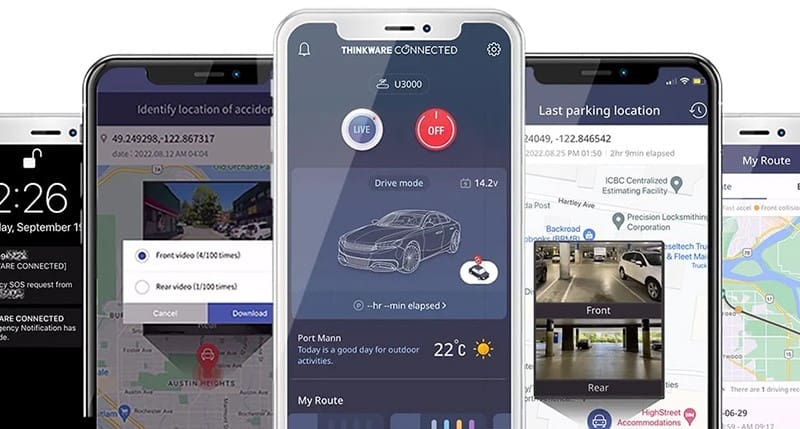
System control options use different technologies. These include Bluetooth interfaces that allow you to control the system from an app on your phone. Smartphone interfaces use the cellular network and an app to let you manage and monitor your vehicle from anywhere in the world – as long as you have a data connection. Proximity keys that unlock the vehicle when you approach it are another option. There are also small keypads that mount to the inside of the windshield so you can type in a code to lock or unlock the vehicle.

Whatever remote control solution you pick for your remote starter, be sure to deal with a reputable retailer to install the system. You want to choose someone who will take their time to perform the installation as reliably as possible. They should be cautious and gentle with your vehicle as they disassemble it to access wiring. They must stand behind the work they do. In many cases, the quality and reliability of the installation are proportional to the price for the system. If the price seems too good to be true, you may want to do some additional research. Online reviews are a great source of information.

Enjoy your remote car starter – it really will make a big difference in the comfort of your vehicle.

This article is written and produced by the team at www.BestCarAudio.com. Reproduction or use of any kind is prohibited without the express written permission of 1sixty8 media.
Filed Under: RESOURCE LIBRARY, ARTICLES, Remote Car Starters

Don’t Suffer with Slow Smartphone Vehicle Control Solutions

Smartphone Vehicle Control

If you’ve been in the market for a new car, truck or SUV recently, you’ve likely encountered the convenience of smartphone control options. These features allow you to perform tasks like locking the doors or starting the vehicle remotely from your smartphone. However, the reality is that many of these factory-installed systems can be frustratingly slow – a common pain point for many of us. You’re not alone in this: A member of our team has two brand-new vehicles in their driveway, both with comparatively sluggish smartphone control systems. Let’s delve into how these systems function, why they’re slow and, most importantly, what solutions can alleviate this frustration.

What Is a Smartphone Control System?

It should come as no surprise that computers control modern cars and trucks. Decades ago, a fuel-injected vehicle might have had a computer to control the spark plugs and fuel injectors. Today, everything from the headlights and infotainment system to the suspension, collision-avoidance systems and engine is controlled by computers. These computers are typically linked through a network data bus. In the not-so-distant future, vehicles will be able to communicate with each other, opening up a world of possibilities. The intention is to reduce accidents and traffic congestion using machine-learning software and your vehicle’s real-time location. These are called vehicle-to-vehicle systems, or V2V for short.

The benefit of linking all the features and systems in a car or truck is that one can respond to another. For example, some luxury vehicles will lower the air conditioning or heater fan speed to make using Bluetooth hands-free calling easier. Some advanced collision-avoidance systems produce warning sounds through different speakers in the vehicle, depending on where an object is. A turn-signal activation might trigger the infotainment system to display the image from a camera on the side of the car. A parking sensor on the vehicle’s rear might apply the brakes to prevent a collision.

We love the simplicity and ease of troubleshooting electrical systems that use mechanical switches and relays. However, the benefits of computer control can’t be denied.

Smartphone Vehicle Control
The ability of the multitude of computers in a vehicle to communicate with each other improves convenience and safety.

Smartphone Control Integration

So, how can an app on a smartphone communicate with the computers in your car or truck? It uses cell phone towers and cellular radios or modems. Unlike an old cell phone optimized exclusively to transmit and receive voice information, modern cellular radio modules are just as good at sending massive amounts of data. Those of us who like to watch YouTube on our phones understand this. Essentially, the phone acts like a modem connected to our home’s cable or phone service provider. However, rather than a wired connection, the information is broadcast over the air to a nearby cell phone tower. From there, it’s on the internet, and you can reach whatever server and website you want.

Most new cars and trucks include a cellular data radio to communicate with a centralized server to provide vehicle information. This connectivity allows commands from the app on your smartphone to be relayed to the vehicle and vice versa.

Say you want to use your smartphone to make sure your truck’s doors are locked before you go to bed. You launch the app on your phone, then press the lock button. The app will send a message, along with your username and password, to a server operated by the vehicle manufacturer or a third-party company contracted to provide the telematics service. The message is already on the internet if connected to your home Wi-Fi. If you aren’t home and are using a cellular data connection, the message is sent to the cell phone tower, which then passes it along to the cell phone provider’s connection to the internet.

After the server has authenticated the message, a new message with the command is sent to your vehicle. This message travels through the internet to the cell phone service provider tied to your car. From there, the message goes to a cell tower near your vehicle. The message is broadcast digitally to the cellular radio in your car. That radio will recognize the command and send a digital message to the body control module to lock the doors.

Once locked, the process reverses. The vehicle confirms that the door lock request has been executed and returns that confirmation to the smartphone app along the same path.

These messages might travel the entire length of a state or province or even across the country to authenticate and execute commands. It is truly fascinating that any of this can happen in a reasonable amount of time.

Smartphone Vehicle Control
Commands from your smartphone app use the cellular data network to communicate with your vehicle.

Benefits of Smartphone Vehicle Control

Having smartphone control of some of your vehicle’s features is extremely convenient. For example, being able to check to make sure the vehicle is locked from your home or office is excellent. With that said, this isn’t a time-sensitive process from the perspective of waiting for the information. However, if you’re walking out of a store or your home and you want to pop the trunk or open the hatch, it would be nice if that were done by the time you got to the car. The same goes for unlocking the vehicle. Sure, most vehicles with smartphone apps also have keyless entry systems. Nevertheless, the app should work fast enough that you are never waiting.

In reality, the choice of cellular data providers and the companies that host the authentication services plays a considerable role in determining the time it takes for your vehicle to respond to commands. If Mazda wanted to reduce operational costs on the MyMazda service, they could select a less expensive, lower-priority service from the cellular data provider. We’ve seen smartphone control systems that take more than a minute and others under two seconds. That’s a significant difference.

Testing Smartphone Apps on Modern Vehicles

We’ll examine smartphone app responsiveness with the MyNissan app and a 2023 Nissan Rogue. After the vehicle had been sitting idle for a few hours, we sent an unlock command from the smartphone. It took 10.8 seconds for the vehicle to respond. We followed this by sending a lock command. That took 3.7 seconds.

Next, we have the MyMazda app and a 2025 Mazda CX-70 PHEV. The test criteria are the same. The vehicle has been sitting idle for several hours. The delay between sending the unlock command and the vehicle responding was 16.6 seconds. The delay to relock the vehicle was 4.7 seconds.

As you can see, sending a second command is much faster. We hypothesize that some of the account authentication processes on the server have already been completed, and your information is now in the cache rather than buried on a storage device.

One MyMazda function regularly used on the Mazda is checking the battery charge status. Oddly, this process takes an abnormally long time – we measured 31 seconds. It’s faster than walking to the vehicle, but not much.

To put these wait times into perspective, the average adult walks about 17 meters or almost 56 feet in 17 seconds. If you are leaving a store and want to remote-start the vehicle, you might be halfway across the parking lot before it gets the start command.

Drone Response Time

Let’s compare this response time to an aftermarket vehicle control solution like Drone from Firstech. You should be familiar with Firstech, which manufactures Compustar remote car starters and Momento dashcams. Sending an unlock command to a vehicle requires less than two seconds. The lock command was executed in under two seconds. We’ve seen a few instances where, just like the OE systems, the first request takes a bit longer than the subsequent, but they are always a fraction of what the OE systems we’ve tested provide.

When the Drone updates, it also provides battery voltage and the temperature inside the vehicle. All of that takes only 2 seconds.

Smartphone Vehicle Control
Smartphone vehicle control solutions like Drone from Firstech provide nearly instant responses to commands.

What about Bluetooth Control?

Some OE and aftermarket smartphone control solutions can communicate with your vehicle using a Bluetooth data connection. Tesla uses this technology in many of its vehicles. Once in range, your smartphone will connect to the vehicle using Bluetooth, and pressing a button in the app will result in a near-instantaneous response from the vehicle. The drawback here is range. Bluetooth might work up to 100 feet under absolutely ideal conditions. This will work as an entry authentication solution but not for something like a remote starter when you are far away.

Shopping for Smartphone Control Solutions

If you want to be able to control and monitor your car, truck or SUV from anywhere in the world where you can access the internet, visit a specialty mobile enhancement retailer and ask them about the solutions they offer.

Before committing to purchasing anything, ask for a real-life demonstration. How long does it take for the vehicle to respond to commands from the phone? Is it a second or two, or slow? Next, ask what functions the system can control in your vehicle. We would expect that door locks are a minimum and that you will likely add this control system to a remote car starter. Beyond that, you may have the option of automatic rear window defroster, heated seat and heated steering wheel activation if your vehicle has those features. Hatch or trunk release is another popular feature, along with sliding door control on minivans.

These days, we need to do everything in our power to keep our vehicles safe. Ask if the control system has geofencing options and if it will provide towing alerts. Find out if you can upgrade the system with a security sensor to monitor for impacts, motion, tilting or glass breakage. Advanced security features are never offered on factory-installed smartphone control systems.

Smartphone Vehicle Control
Ensure that the solution you choose can provide security alerts to help keep your vehicle safe.

Once you have a clear image of the options available, you can choose those that meet your needs. Of course, features and pricing aren’t all that matter when selecting a shop to upgrade your vehicle. Do your research to make sure that the technicians working on your car or truck are appropriately trained, use reliable connection methods and pay attention to the details when integrating the system into your vehicle. Look to see if the shop uses seat, steering wheel and fender covers while working on the vehicle. Find out if they put the vehicle battery on a charger to keep it topped up while they have the doors open. All these small items seem simple, but they are signs that the shop you are researching cares about their work and your car or truck.

This article is written and produced by the team at www.BestCarAudio.com. Reproduction or use of any kind is prohibited without the express written permission of 1sixty8 media.
Filed Under: RESOURCE LIBRARY, ARTICLES, PRODUCTS

Revisiting the Rockford Fosgate R2-1200X1 Test Drive Review

R2-1200X1 Test

In late October 2023, we had the opportunity to give the Rockford Fosgate R2-1200X1 subwoofer amplifier a thorough Test Drive Review (https://www.bestcaraudio.com/test-drive-review-rockford-fosgate-r2-1200×1/). We were very impressed that this entry-level amp had features and performance that dramatically outperformed entry-level and mid-level products from other brands.

Power Testing and the Importance of Supply Voltage

The original test had one hiccup. When running a 1-ohm load, the amp produced 1,155.3 watts, which is a few watts (44.7) shy of the rated 1,200 watts the amp should produce.

Why did this happen? Is the R2-1200X1 not a real 1,200-watt amplifier? The answer lies in the power supplies we used to feed the amplifier. The supplies, a pair of Stinger SPS80 units, don’t have an output voltage adjustment. We’ve used their high- and low-voltage settings to show how different amplifiers perform at different supply voltage levels. The problem is, amplifiers tested to the ANSI/CTA-2006-D specification must be supplied with 14.4 volts. We only fed the R2-1200X1 13.61 volts. So, making just 44 watts shy of the rating, with 0.79 volt less than is expected, is actually impressive.

We typically explain that minute differences in output power are inaudible. The difference in output level between 1,155.2 and 1,200 watts is only 0.16 dB. You can’t hear that difference. Nevertheless, car audio enthusiasts want to see the largest numbers possible regarding power ratings … for some reason.

R2-1200X1 Test

New Power Supplies Fix Everything

After months of research, we have purchased two new 100-amp, 15-volt power supplies for the BestCarAudio.com test bench. The new supplies have an adjustable output, so we can fine-tune them to produce precisely 14.4 volts to ensure that the measurements we provide fully comply with the ANSI/CTA-2006-D specification. We use our QuantAsylum QA403 audio analyzer to measure harmonic distortion and noise and adjust the output level to be within a tenth of 1% THD+N.

Repeating the Rockford Fosgate R2-1200X1 Test

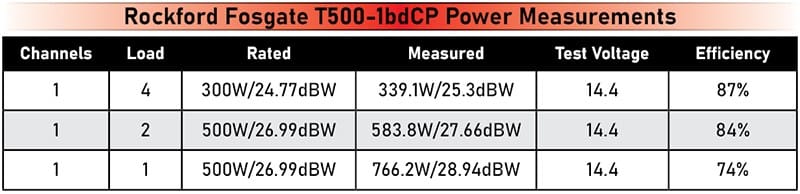
With the new supplies wired up and a few wires re-terminated, it was time to repeat the power measurements. As you can see from the chart below, the impressive R2-1200X1 does indeed produce every bit of power that Rockford Fosgate claims – and more. If you’ve been paying attention to the other products we’ve tested from them, that should be no surprise.

R2-1200X1 Test

We picked up 27.3 watts at 4 ohms, 36.5 watts at 2 ohms and an impressive 109.9 watts when driving a 1-ohm load.

Distortion Versus Output Graphs

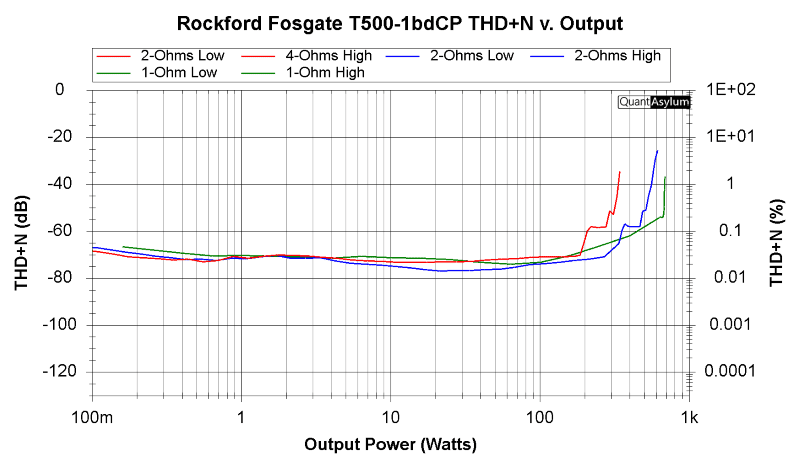
While the amp was back on the bench, we generated THD+N versus power output graphs for each load. The graphs show total harmonic distortion and noise on the vertical scale and power output on the horizontal scale.

R2-1200X1 Test

R2-1200X1 Test

R2-1200X1 Test

Different amplifier designs have different characteristics regarding how they add harmonic distortion to the signal. The R2-1200X1 behaves well, with moderate THD+N increases as output levels rise. There’s nothing bad or unexpected in any of the measurements.

Why Does More Power Supply Voltage Increase Maximum Power Output?

Before we close, we should discuss why increasing the supply voltage increases an amplifier’s maximum power. In the case of this amp, the power supply is unregulated – or, at the very least, loosely regulated. In terms of practical explanation, the voltage supplied to the amp is multiplied by a fixed amount to create the rail voltages that drive the output.

If we had to guess, the R2-1200X2 takes the supply voltage and multiplies it by roughly 2.25. This gives us positive and negative rail voltages of approximately +32V and -32V. The audio signal can swing between these voltages, giving us just over 44.3 volts RMS available to drive the subwoofer. At 4 ohms, that’s just under 500 watts.

At lower impedances, the limiting factor in how much power the amp can produce is the power supply’s current delivery capabilities. We measured 41.4 volts into a 2-ohm load and 35.57 volts into a 1-ohm load. Once again, this is entirely normal behavior for a high-quality amplifier.

Check out the R2-1200X1 for Your Car Audio Subwoofers

If you’re shopping for an affordable subwoofer amplifier that sounds good, offers fantastic efficiency and includes all the features you need to make your car audio system sound great, drop by a local authorized Rockford Fosgate retailer and check out the R2-1200X1. Be sure to tell them the gang from BestCarAudio.com sent you!

This article is written and produced by the team at www.BestCarAudio.com. Reproduction or use of any kind is prohibited without the express written permission of 1sixty8 media.
Filed Under: RESOURCE LIBRARY, ARTICLES, PRODUCTS Tagged With: Rockford Fosgate

Subwoofer Enclosure Locations – Finding Space For Bass

Enclosure LocationsWhen it comes to bang-for-the-buck upgrades to any audio system, none can beat the dramatic difference of adding a subwoofer. Factory audio systems are getting pretty good at producing a soundstage in front of the listener, and they are EQed well enough not to be painful to enjoy – but one thing they all have in common is anemic, wimpy, thin and muddy bass response. Adding a quality subwoofer system can fix that.

What are optimal subwoofer system enclosure locations? If you think of the stereotypical car audio system, the subwoofer enclosure was usually something that took up most of the trunk or hatch area of the vehicle. You’d pop the trunk, and there would be just enough room for a knapsack or maybe a duffle bag. Did these systems sound great? Absolutely! Did they leave room for golf clubs, luggage or a keg of beer? Not a chance!

Subwoofers for Compact Enclosures

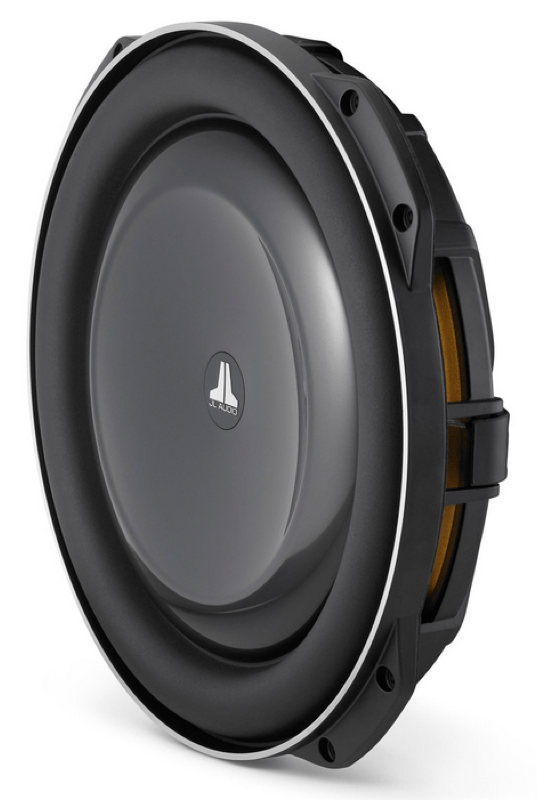
Enclosure LocationsLooking through recent photos of custom car audio installations will reveal that subwoofer enclosures no longer take up space they once did. Why is this? Companies that design and manufacture subwoofers are conscious of the need to provide amazing performance without taking up a lot of space. There are now dozens of subwoofers designed specifically to fit into very shallow locations – like behind or under the seat of a pickup truck. These same subwoofers are also designed to produce deep bass from minimal enclosure volume requirements.

When a company designs a speaker, they have to balance three basic performance criteria – low-frequency extension, efficiency and enclosure volume requirements. In general terms, you get to pick two, and the third will suffer. For a small enclosure driver, it’s often efficiency that takes a small hit. Regaining some of this reduction in output is credited to careful and thoughtful computer modeling and the use of stronger magnets and tighter tolerances withing the motor assembly of the subwoofer. Efficiency isn’t as important as it used to be – we have many high-power amplifiers that don’t cost an arm and a leg.

Conventional Enclosure Locations

Enclosure Locations
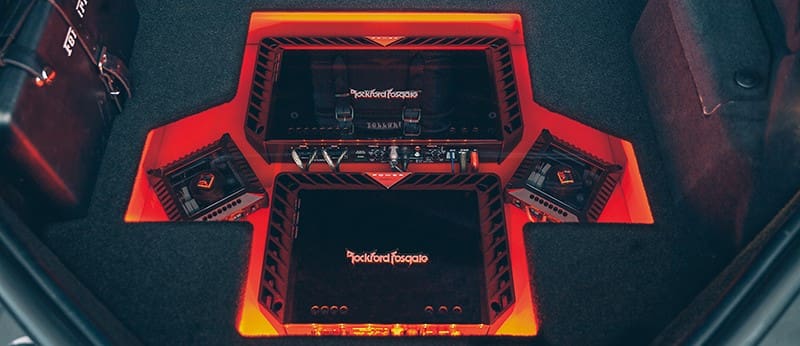
Custom enclosure and amplifier rack in SUV hatch.

If you drive a hatchback or SUV, a subwoofer sitting behind the rear seat is still very common. This location works quite well because the output of the subwoofer system is in the same listening environment as it would be in a sedan. Your installer may choose to face the subwoofer in almost any direction – rearward, forward, up or down. Firing the subwoofers down into the floor can act as a bit of a filter for high-frequency energy, so your midbass speakers have to be up to the challenge.

If you drive a sedan, your subwoofer system is probably at the back of the trunk against the rear seats – much like in hatchbacks or SUVs. Again, the direction in which the speaker points varies based on the system design and cosmetic layout. Firing the subwoofers forward provides room to mount amplifiers and processors on the rear of the enclosure.

Another popular application for sedans is to fire the subwoofers through the rear deck or ski pass-through between the seats. These techniques dramatically improve the midbass response from the subwoofer and ease the requirement for large midbass drivers in the front of the vehicle.

A Little Custom, A Little Fun

Working with unique locations can offer a dramatic increase in the available storage area in the vehicle. There are two classic locations for a custom subwoofer enclosure: in the spare tire well or the corner of the trunk or storage area.

Enclosure Locations
A creative installer can fit a surprising amount of equipment in a spare tire well, while leaving the trunk fully functional.

The spare tire well of many vehicles can offer an amazing amount of space for subwoofers. In many cases, a skilled installer can include your amplifiers and processors in that same space. Some thoughtful design and careful planning can leave you with your entire trunk available for cargo. You do need a plan for not having your spare tire with you – but the local auto service is always a phone call away.

Enclosure Locations
This SUV side enclosure takes up almost no usable space.

Building an enclosure in the corner of your trunk can offer excellent performance without a dramatic effect on available cargo space. Installers love to get creative with these enclosure designs. Classically, these enclosures have been molded to the vehicle with layers of fiberglass. Layered fiberglass construction offers excellent use of space, sometimes allowing for a larger subwoofer to be used with the same low-frequency performance, or even for a vented enclosure design. The drawback to fiberglass can be the time it takes for construction, and the smell. Fiberglass resin has a strong odor. It won’t last long, but that aspect is worth keeping in mind.

Another construction technique that is becoming more and more popular is stack-fab. The stack-fab process uses multiple layers of wood. Each is cut to fit the contour of the vehicle, then glued one on top of another until your installer has built up to the top of the desired space. Stack-fab construction can be quite efficient in terms of time. The enclosure is ready to go right away. There is no waiting for layers of fiberglass and resin to dry. Stack-fab isn’t as efficient on internal air space, but produces a very rigid and well-damped result.

Unique Applications and Solutions

Enclosure Locations
In many instances only an inch or two of legroom has to be given up to utilize a footwell enclosure.

What if your vehicle is a little more challenging than most? Say you have a small two-seater like a Miata or an NSX, but want great sound? There is no room behind the seat for anything. What’s an auto sound enthusiast to do? The passenger side footwell can be a great location for a subwoofer. A skilled installer can get a good-quality 8- or 10-inch subwoofer in there while leaving more than enough room for the passenger to sit comfortably in the vehicle.

Wherever you and your installer decide to place your subwoofer enclosure, the addition of good, solid low-frequency musical information will dramatically improve the overall performance of your mobile audio system. Search the Internet and join one of the many car audio groups on Facebook to gather ideas. Once you have a few thoughts, talk with the product specialist and installer at your local mobile electronics specialist retailer. No doubt, the result will be amazing!

This article is written and produced by the team at www.BestCarAudio.com. Reproduction or use of any kind is prohibited without the express written permission of 1sixty8 media.
Filed Under: Car Audio, ARTICLES, RESOURCE LIBRARY

Passive Vs Active Crossover Networks

Crossover NetworksTo optimize the performance capabilities of a speaker, it should operate within the frequency range for which it was designed. A woofer or subwoofer won’t be able to reproduce high frequencies accurately. A tweeter will self-destruct if you ask it to try to play bass frequencies. For this reason, we use three- and four-way speaker systems in most vehicles. That means using crossover networks.

The purpose of a crossover is to split up the frequencies that pass through it. We are going to delve waist-deep into the benefits and drawbacks of the crossovers commonly used in car audio system component speaker sets.

How a Passive Crossover Network Works

Crossover Networks
This inductor is one of the pieces used in a passive network

A passive crossover network is a component or group of components that is installed on the speaker wires between an amplifier and a speaker. The behavior of these components attenuates portions of the signal going to the speaker itself. Four components are commonly used in passive networks: capacitors, inductors, resistors and protection devices.

The combination and configuration of these components are used to create a low-pass, high-pass or band-pass filter network. Resistors are used to attenuate the output of devices, or sometimes used as part of a frequency-dependent impedance correction circuit called a Zobel network. Some manufacturers include light bulbs, diodes or some form of positive temperature resistors to limit how much voltage a tweeter receives. Completely passive active networks have been available (but that was a long time ago).

How an Active Crossover Functions

Crossover NetworksAn active crossover is a device that modifies an audio signal before the amplifier. It works on line-level or preamp signals only. Active crossovers combine op-amps, resistors and capacitors to alter different frequency ranges of the signal. Unlike passive networks, active crossovers can be designed to increase the level of the signal, but only in the case of powered filters. Active networks are often include other functions, such as remote level controls and bass boost circuits.

Benefits of Passive Crossovers

Crossover Networks
The switches on this passive crossover allow for attenuation.

It is worth noting that each passive network is designed to work at a specific frequency for a specific speaker. If you change the speaker, the filter will not respond in the same way. In some cases, if the impedance of the speaker is significantly different from the one the network was designed for, the speaker may be damaged, or portions of the network may become damaged.

Passive networks are easy to use. You run a wire from your amplifier to the input of the network, then connect each speaker to the output. Other than mounting the network in a dry location that is free from vibration, that’s about all you have to consider.

Some passive networks include some form of output level attenuation. Most use a two- or three-position switch. Some use jumpers. An extremely high-end network may include a variable L-pad or potentiometer for extreme fine-tuning capabilities.

Passive crossovers allow you to split the power of a single amplifier channel to drive two different speakers. Fewer amplifier channels can dramatically reduce the system cost, since you only need a pair of amplifier channels to run a full set of speakers.

Limitations of Passive Crossovers

Since a passive crossover network is designed for a specific frequency, once the parts are chosen and assembled, there is no way to change that frequency without introducing new or additional parts.

Designing a passive crossover can be somewhat complex. The simplest of networks rely on some basic assumptions about the impedance of each speaker at the crossover frequency. Designing a network that compensates for the complex reactive load that speakers create as they move is difficult. It requires computerized modeling software and a way to measure the impedance and frequency response of the speaker at varying drive levels.

High-quality passive crossovers are designed for a specific distance and angle between the woofer and the tweeter. If the network is designed for the speakers to be far apart, moving the speakers close together will cause the signals to sum incorrectly. Even changing the angle of a speaker can have a dramatic effect on the frequency response at the crossover point.

Passive crossover networks have limitations in how much power they can handle. The magnetic fields created in an inductor have a limit. The voltage applied to a capacitor also has a limit. Crossover networks can and do overheat and fail if too much power is sent to them.

Passive crossover networks consume energy. Using a speaker system with a passive network is not quite as efficient as one using an active filter network. The overall efficiency of the crossover network depends on its complexity and the quality of the components used in the network.

Passive crossover networks are somewhat susceptible to noise. If you run a wire with an AC signal on it past the inductor in a passive network, the network can easily pick up that signal and add it to the audio signal. Choosing a safe location to mount passive crossover networks is important.

Benefits of Active Crossovers

Crossover NetworksMost active crossover networks are adjustable. That means by turning a knob or moving a switch, you can change the crossover frequency. This flexibility makes active crossovers suitable for use with almost any speaker system. Most active crossovers also include level controls, so you can easily fine-tune the level of the midrange and tweeter to compensate for different mounting locations.

Active crossovers don’t care how powerful your amplifiers are because they process the signal before it enters the amplifier. Active crossovers are also not very sensitive to temperature variations, so they can be very accurate, all the time. If one of the amplifiers channels in an active crossover system clips, the distortion only affects that single channel.

Challenges of Active Crossovers

Because active crossovers are universal in design, being able to set crossover frequencies accurately can be challenging. Labels on potentiometers are notoriously inaccurate. Most active crossovers have fixed attenuation slopes. You can’t change these slopes to compensate for response characteristics or placement variations. Unless the speaker manufacturer provides it, or you have extensive experience in measuring the electro-mechanical and acoustic response of the set of speakers, knowing what frequency to cross speakers over at can be difficult. Too low and you risk damage to the tweeter. Too high and you get distortion from the midrange. Many speaker combinations also require the over- or under-lap of the crossover frequencies to produce a flat response.

An active crossover requires a dedicated amplifier channel for each speaker. These extra channel requirements can increase the cost of designing a system.

The Perfect Solution

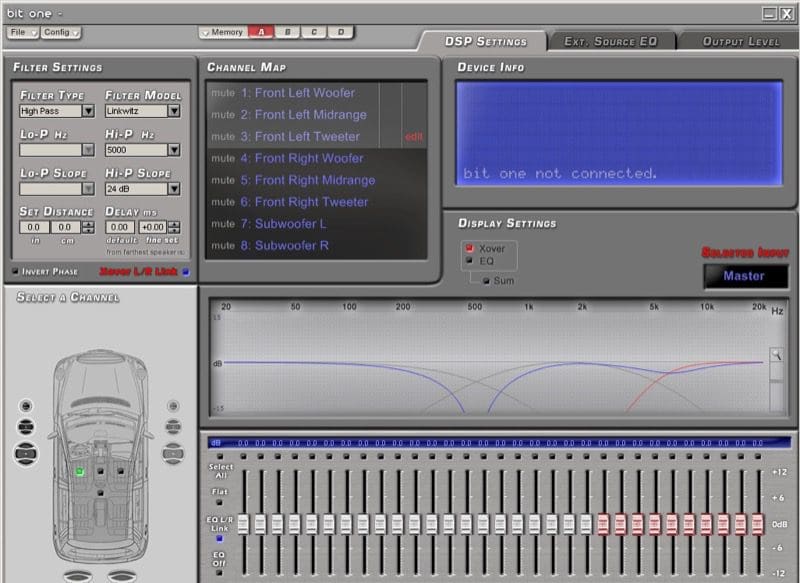
Crossover NetworksIf there is no limit to your budget, the ideal crossover solution for a set of speakers is an active crossover with a Digital Sound Processor performing the filtering. A DSP will offer adjustable crossover frequencies, and most offer adjustable crossover slopes and alignments.

No matter what you choose, it’s a good idea to spend some time with a high-resolution RTA to make sure your system is set up for the smoothest, flattest response possible at the crossover frequency.

This article is written and produced by the team at www.BestCarAudio.com. Reproduction or use of any kind is prohibited without the express written permission of 1sixty8 media.
Filed Under: RESOURCE LIBRARY, ARTICLES, Car Audio

  • « Previous Page
  • 1
  • …
  • 8
  • 9
  • 10
  • 11
  • 12
  • …
  • 17
  • Next Page »

Recent Articles

Product Spotlight: Rockford Fosgate P2V2-65

Product Spotlight: Rockford Fosgate P2V2-65

January 5, 2026 

Rockford Fosgate revamped its entire Punch Series speaker lineup and launched it at SEMA 2025. Rather than the good, better, best arrangement of previous years, they’ve created … [Read More...]

Rear Speakers

Rear Speakers – A Benefit or a Bad Habit?

January 4, 2026 

For decades, automobile manufacturers have installed relatively large rear speakers in their vehicles. The stereotype of a set of 6x9 speakers sitting on the parcel shelf of a … [Read More...]

Rockford Fosgate Punch P1V2-65

Product Spotlight: Rockford Fosgate Punch P1V2-65

December 15, 2025 

If there is a single word that car audio enthusiasts associate with the brand Rockford Fosgate, that would be “Punch”. From the early Punch amplifiers, speakers and subwoofers, … [Read More...]

A woman looking at various types of remote starters

Choosing the Best Car Starter Remote

December 8, 2025 

Under the hood, most remote car starters are very similar. Most brands offer two or three different controllers and allow the shop you work with to bundle those units with … [Read More...]

The steering wheel and dash of a vehicle

Basics of OEM Integration in Your Newer Vehicle

December 7, 2025 

Installing a mobile audio system involves much more than just hooking up some wires and driving in a few screws. Almost all vehicle manufacturers have realized that some amount of … [Read More...]

Subscribe!

Enter your email address to subscribe to our website and receive notifications of new posts by email.

Join 8 other subscribers

Testimonials

Nice staff and honor their work

Audio Crew did some work for me about 2yrs ago. A speaker they installed wasn't working properly. They checked it out and problem was a corroded wire. They fixed the problem and told me no charge for the repair. Very nice of them to do that as problem wasn't their fault in the first place. Audio Crew have a nice staff and honor their work.

VERY HONEST and PROFESSIONAL company

I purchased a 2019 used car for my wife and she wanted a remote started installed. I went to Audio Crew, who I had dealt with before, got a price and made an appointment. We dropped the car off the night before, for the appointment with a request that they call us when ready. Early the next morning, I received a call telling me that there was good news!! The car already had a remote starter which was programmed into the factory remote. We only need to press the "lock" button three times to star the car!! The dealer who sold us the car was not aware of that, it was a pleasant surprise to us and a $350 savings. THANK YOU to a VERY HONEST and PROFESSIONAL company.

Absolutely the best service

Absolutely the best service you will get anywhere. They go above and beyond! Can’t recommend them more! They fixed our issue quickly. Super friendly and helpful. Will not buy anywhere else.

Great Service

Great service, huge demo room with great prices. Very knowledgeable and professional service from the owner and will work within your budget to help you achieve your goals in the sound system your looking for. Extremely great experience dealing with them, also pricing was excellent competitive prices.

Subscribe to Our Website

Enter your email address to subscribe to our website and receive notifications of new posts by email.

Location


Get Directions to Audio Crew

Address

Audio Crew

624 Salisbury Rd
Moncton, NB E1E 1B8
506-858-2739

Connect With Us

  • Facebook
  • Instagram

Services

  • Car Audio
  • Marine Audio
  • Motorcycle Audio
  • Remote Starters
  • UTV and Side-by-Side Upgrades

Store Hours

Monday, Tuesday, Wednesday, Thursday, Friday8:30 am – 5:00 pm

Copyright © 2026 Audio Crew · Privacy Policy · Website by 1sixty8 media · Log in


Loading Comments...