Audio Crew

Serving the Greater Moncton Area and All of New Brunswick

624 Salisbury Rd, Moncton, NB E1E 1B8, Canada 506-858-2739
  • Home
  • Services
    • Car Audio
    • Marine Audio
    • Motorcycle Audio
    • Remote Starters
    • UTV and Side-by-Side Upgrades
  • About Us
  • Location
  • Contact Us
  • Facebook
  • Instagram

Basics of OEM Integration in Your Newer Vehicle

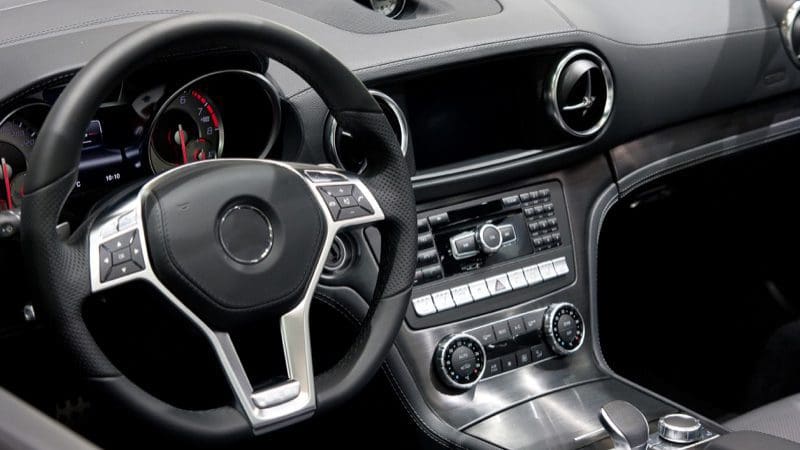
OEM IntegrationInstalling a mobile audio system involves much more than just hooking up some wires and driving in a few screws. Almost all vehicle manufacturers have realized that some amount of audio system tuning will dramatically improve their customers’ experience. When you decide it’s time to upgrade your factory audio system, we need to take into account any tuning that may have been done by the factory. It’s not easy, but at the same time, it’s not impossible. This article provides a brief look at what is involved in connecting a new amplifier and speakers to your factory source unit or amplifier, or as it is called, OEM integration.

It’s Not Flat

No, we aren’t talking about the Earth. One of the first steps in designing a premium audio system upgrade is to measure the electrical signal that is being sent to each of your speakers. Why? As we mentioned, more and more factory source units and amplifiers include advanced signal processing. Even some of the most basic audio systems with only four speakers have custom equalization for each speaker. Once our installers know what they are dealing with, they use that information in designing your new system.

OEM IntegrationThe signal measurement process should be done before system design. If the signal is flat (no equalization), then the system design may take a different direction from when the signal is equalized. Compensating for factory equalization requires that some kind of equalizer be installed in the new system. Either way, we have to allot time to measure the acoustical response of the new system and make appropriate adjustments.

Think of this process as though your installer were a surgeon preparing to solve a medical problem for you. The surgeon will order x-rays, scans and many tests long before you’re on the operating table. Nobody wants to start work on a project without knowing what they are dealing with. Modern car audio systems are no different.

Front and Center
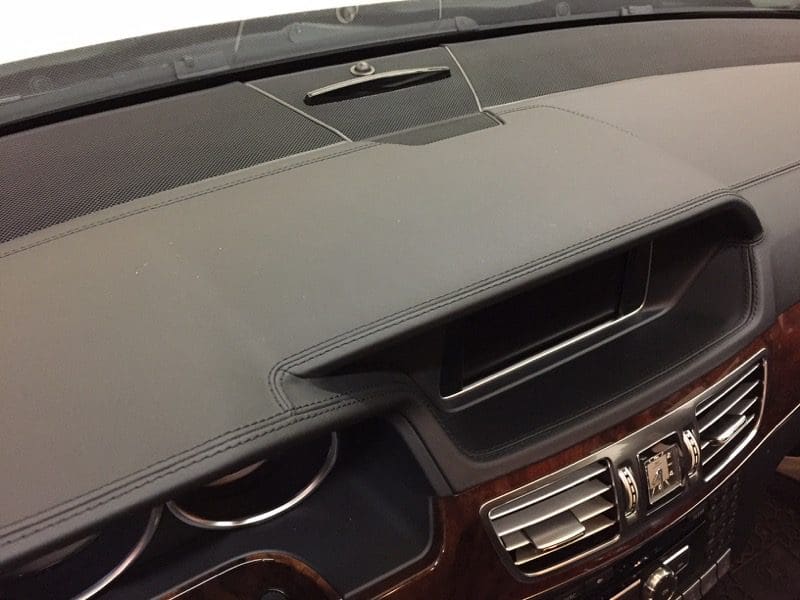
OEM IntegrationAutomobile manufacturers strive to make all their customers happy – within a certain budget. This goal includes providing an enjoyable audio experience for everyone in the vehicle. Many mid- and high-level factory audio systems use a center channel to help create a listening experience that is enjoyable for both occupants of the front seats. Configured properly, a center channel can help create a realistic soundstage from both seating positions. Trust us when we say that some of the people who tune these factory audio systems have a lot of experience doing what they do.

When we want to upgrade the audio system in a vehicle with a center channel, we have to reverse-engineer how that speaker is functioning. Is it a mono signal that is the sum of the left and right signals? Is it an up-mixed signal that plays sounds that are not reproduced by the left and right speakers? It could also be a little bit of both. Your installer will have to do some tests to decide what is happening and how to deal with it.

Do We Undo or Up-do?
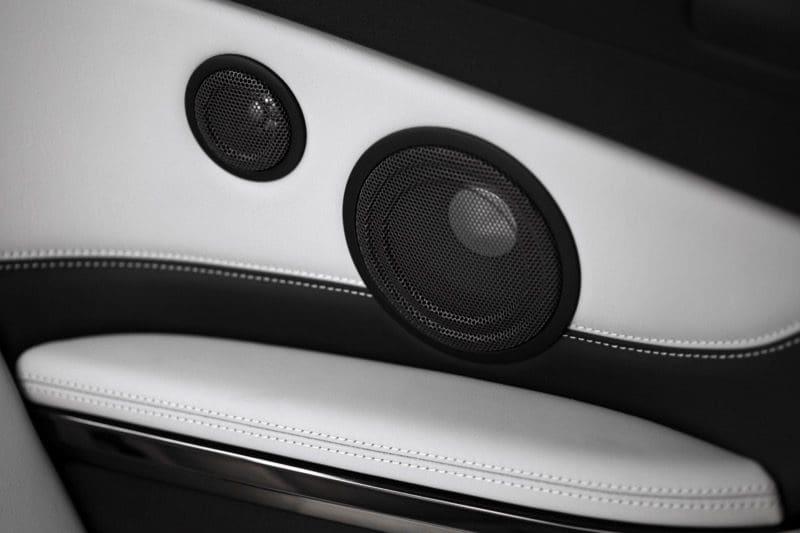
OEM IntegrationIf you have a vehicle with a genuine up-mixed center channel, one of the best ways to upgrade the audio system is to leave the processing alone and add better speakers, amplifiers and signal processing. With this method, we can create a sound system that sounds amazing from both the driver and passenger seats.

The basic concept is to take the left, center and right signals; recombine any frequency filtering; then send those three signals to whatever speakers you choose for each side of the vehicle and the new center channel. Often, the new system will be a three-way speaker set in the doors and maybe the A-pillars, and a two-way system in the center. We will most certainly use a digital signal processor and/or an integration processor to do the signal filtering and tuning for the new system.

How We Undo What They Do
OEM Integration
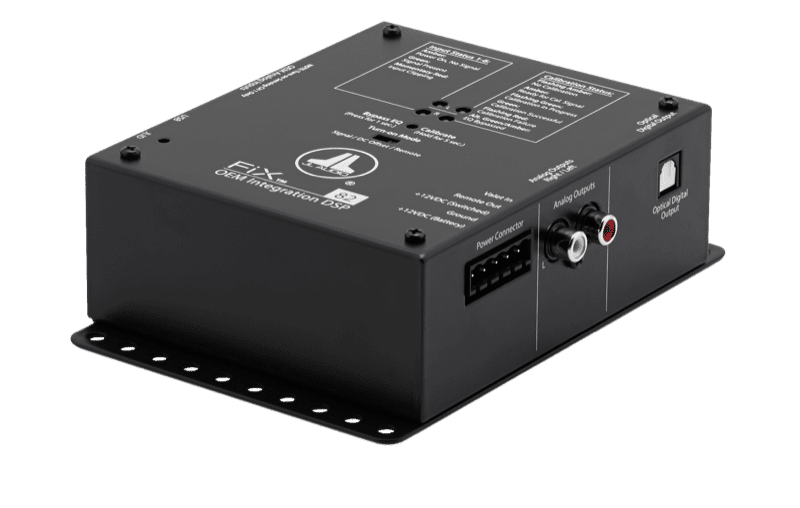
The JL Audio Fix 82 can “fix” a number of factory signal problems.

Several processors on the market can sum filtered channels together and undo factory equalization and time alignment. Some of these processors require manual adjustments and some work automatically with a custom setup track. After using one of these processors to provide a full bandwidth signal, we can then use digital signal processing to set up the new system and compensate for the vehicle acoustics. Just as the vehicle manufacturer chose to equalize the signal going to each speaker, we need to do this to maximize the performance of your new system.

What if We Don’t Undo What They Did?

Imagine a simple scenario: You have a car, perhaps a Nissan Altima. Even the base model audio system has equalization in this vehicle. Equalization is based on the speaker that is being used, location of the speaker and acoustic effects of the vehicle on the signal from that speaker relative to the listening position. If we change the speaker to one that is better, the factory equalization can – and most likely will – work against us. That nice new speaker may sound worse than the cheap factory speaker. After all, the manufacturer tried to make what was likely a low-quality speaker sound OK.

Trust Your Local OEM Integration Experts

When it comes time to upgrade the audio system in a fairly new vehicle, make sure you are working with a mobile electronics retailer that knows how to evaluate the existing audio system properly. If you are changing the source unit, then it’s no big deal. But if you are using the factory radio and/or amplifier, proper testing is crucial. Don’t be scared or discouraged. A well-trained retailer can transform any audio system into something truly amazing! Drop in and see what they can do for you.
This article is written and produced by the team at www.BestCarAudio.com. Reproduction or use of any kind is prohibited without the express written permission of 1sixty8 media.
Filed Under: ARTICLES, Car Audio, RESOURCE LIBRARY

Product Spotlight: Rockford Fosgate M2-200X2

Rockford Fosgate M2-200X2

Having a great-sounding audio system on your boat is one of the best ways to improve your time on the lake or ocean. Rockford Fosgate is an industry leader in marine audio products. Their speakers, subwoofers, source units and amplifiers are at the heart of some of the best-sounding boats on the water. Let’s check out the Punch Series M2-200X2 amplifier in this product spotlight.

Specifications of the Rockford Fosgate M2-200X2

The M2-200X2 is a two-channel amplifier that’s rated to produce 50 watts of power per channel into four-ohm loads. When the load impedance is two ohms, power output increases to 100 watts per channel. The amp can be bridged to deliver 200 watts of power into a single four-ohm load.

From a perspective of performance, Rockford Fosgate rates the amp as having a bandwidth of 20 Hz to 20 kHz and a THD spec of < 1.0%. Having tested several Punch amplifiers in our labs, we know that they dramatically outperform these modest specifications. We’ve seen frequency response measurements that are within 3dB to well below 5 Hz, and THD numbers in the <0.02% range. Punch and Power series amplifiers not only measure well on the bench, but they also sound excellent.

Rockford Fosgate M2-200X2
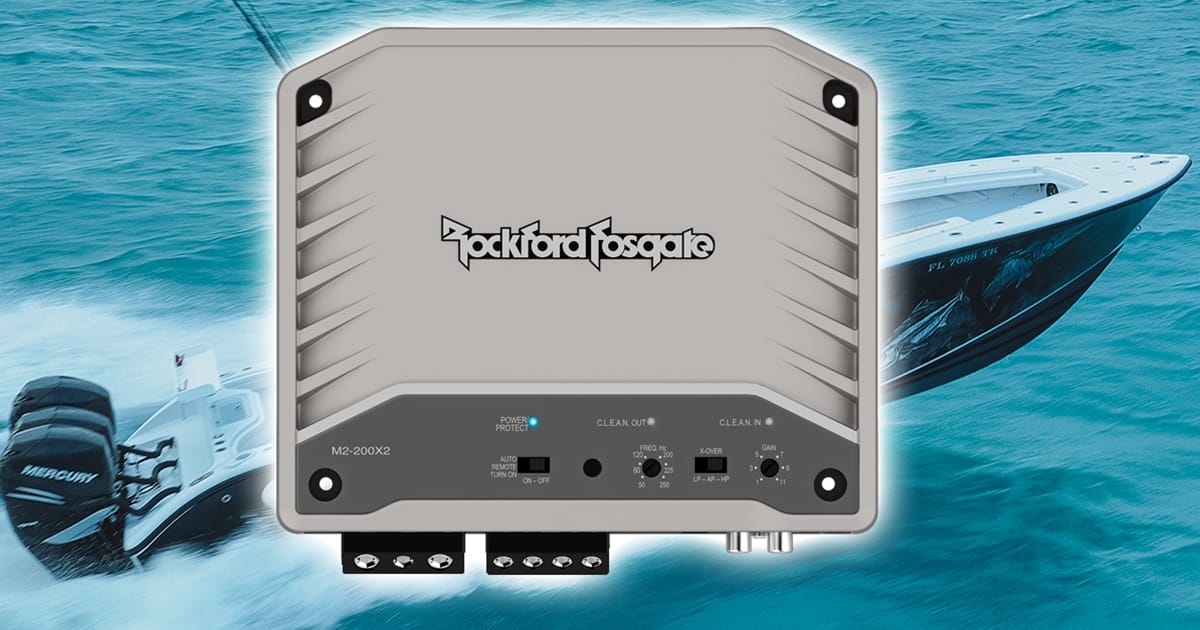
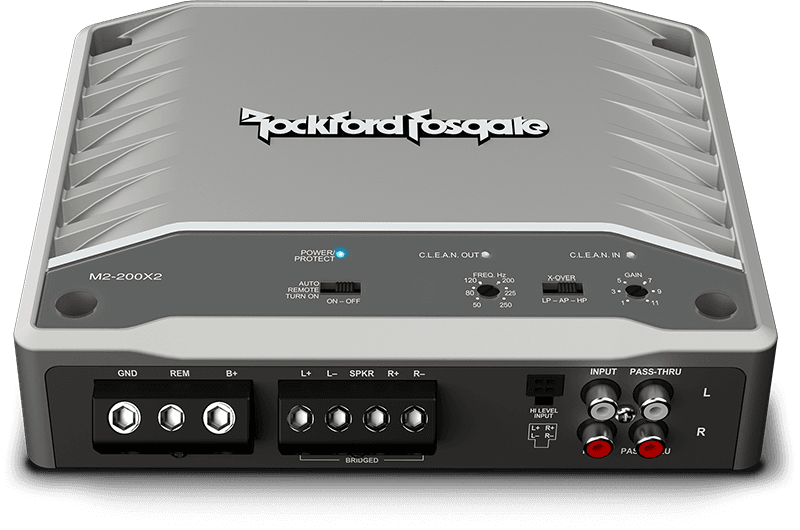
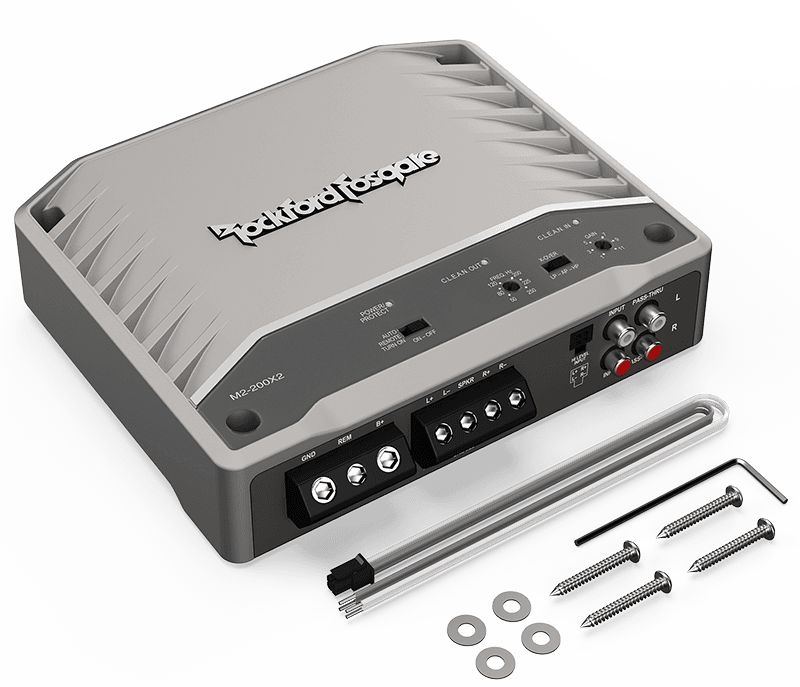
The M2-200X2 is a two-channel amplifier designed to withstand the challenges of marine applications.

Marine Stereo Amplifier Features

The M2-200X2 is based on the same cast aluminum heatsink design as the Punch Series amplifiers. These high-mass heatsinks are a key component in determining reliability and thermal stability at high power levels. Indeed, there are many compact amps on the market that make similar power claims. However, we doubt they will play at full power for more than 30 minutes without overheating.

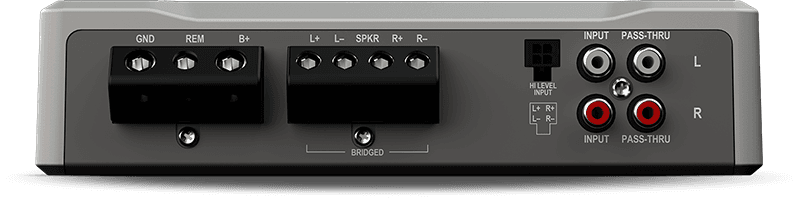
The M2-200X2 has a footprint of 6.8 by 8.1 inches and stands 1.9 inches tall. All the power, signal and speaker connections are made along the front edge of the amp to keep the installation tidy. Angled terminal blocks accept 4-AWG power and ground connections, while a smaller block accommodates at least 12-AWG speaker cables.

The amplifier has a pair of RCA input jacks that will accept up to 4 volts. Adjacent to the speaker jacks is a Molex plug for speaker-level inputs. This will take up to 12 volts of signal. The amp has an Auto Remote Turn-On feature that monitors the inputs for the presence of the BTL offset voltage from a head unit or similar amplifier. This is an excellent feature if your installer is connecting the amp to a radio that doesn’t have RCA outputs.

Rockford Fosgate M2-200X2
Power, signal and speaker connections are made via zinc-coated brass terminals along the front edge of the amp.

Signal Processing

The Rockford Fosgate M2-200X2 has a variable crossover that can be adjusted from 50 Hz to 250 Hz. The slope is -12 dB per Octave and features a Butterworth alignment. A switch on the top of the amp allows your installer to select between high-pass or low-pass operation, or to bypass the filtering completely.

The M2-200X2 features Rockford Fosgate’s C.L.E.A.N. circuit on both the input and output, allowing your installer to optimize the amplifier’s power and noise performance. The C.L.E.A.N. LED indicators illuminate when maximum power is achieved.

Element Ready Design

Rockford Fosgate rates the M2-200X2 as being Element Ready. In this application, the amp is constructed with corrosion-resistant materials like a UV-resistant powder-coated cast aluminum heatsink and corrosion-resistant zinc nickel-plated brass hardware. Where the moniker becomes more critical is the use of a conformal coating on the circuit board to prevent corrosion in environments with high salt content. Furthermore, the board and its attached components can withstand impacts and vibrations that would cause problems with lesser products. If your boat takes a pounding as you jump over waves, then this physical stability is crucial to the longevity of your marine audio system.

Rockford Fosgate M2-200X2
The M2-200X2 includes mounting hardware and a hex key to make installation straightforward.

Upgrade Your Boat with Rockford Fosgate Marine Audio

If you are shopping for a great-sounding, reliable amplifier to upgrade your marine audio system, drop by a local authorized Rockford Fosgate retailer and ask about the M2-200X2. This stereo amplifier is an ideal solution for powering a few sets of speakers or a subwoofer. In fact, running two of them would make for a perfect two-way marine audio system that can play for hours and hours.

Visit the Rockford Fosgate website and use their dealer locator to find a shop near where you live. While online, be sure to follow Rockford Fosgate on Facebook, Instagram and YouTube to learn about their impressive marine audio upgrade solutions.

This article is written and produced by the team at www.BestCarAudio.com. Reproduction or use of any kind is prohibited without the express written permission of 1sixty8 media.
Filed Under: ARTICLES, Car Audio, PRODUCTS, RESOURCE LIBRARY Tagged With: Rockford Fosgate

Why are Speakers Different Sizes?

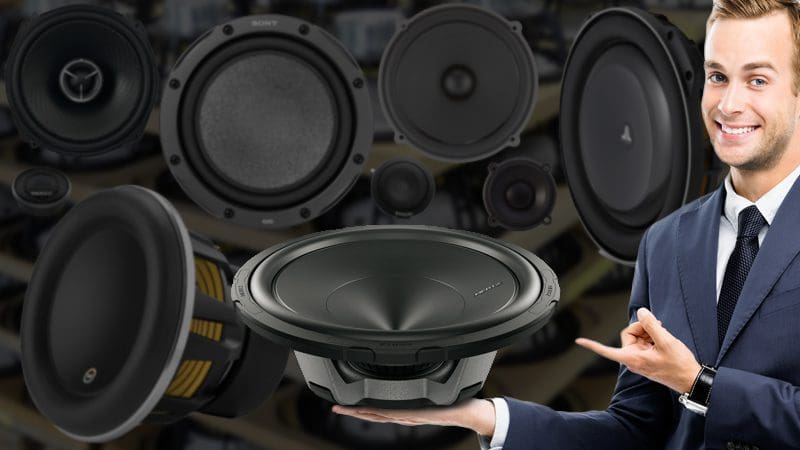
Speakers Different SizesWhen you head to your local mobile electronics specialist in search of new speakers, there are a few criteria to keep in mind. Choosing a speaker size can go one of two ways: You can pick something that fits a specific mounting location or you can choose based on the characteristics of the speaker relative to its size. Are you interested in knowing why speakers come in different sizes? Good! You’ve come to the right place.

What Does a Speaker Do?

It is the job of a speaker to convert the electrical signal from your amplifier into motion. The motion of the speaker cone excites the air around it. As the cone moves forward, the air in front of the cone is pressurized. As the cone moves rearward, the air is rarefied. These pressure waves extend out from the speaker and our ears detect these minute changes in pressure as sound. Pretty simple, isn’t it?

Things to Consider in Terms of Reproducing Sound

Speakers Different SizesWhen it comes to reproducing sounds, the lower the frequency, the harder it is to produce the sound. For every doubling of frequency, the speaker cone has to move a quarter the distance to produce the same level of output. As example, if your subwoofer has to move 2 mm to produce 95 dB of output and 40 Hz, it only has to move 0.5 mm to reproduce 95 dB at 80 Hz. To reproduce 95 dB of output at 160 Hz, the cone only has to move 0.125 mm.

The size of a speaker cone affects how much sound the speaker will create for a given amount of input signal. Let’s generalize things a little (because a lot of external factors affect this statement): A 12-inch speaker cone has to move twice as far as a 15-inch speaker cone to produce the same amount of output at a given frequency. That also means the 12-inch speaker requires more power to produce the same sound as the 15-inch.

Bigger is Always Better, Right?

Based on this logic, you should simply select the biggest possible speaker for every application, right? Well, it’s not quite that easy. When we get into midrange and high frequencies, the speaker cone has to move back and forth very fast. A 1,000 Hz tone requires that the speaker move forward and backward 1,000 times a second. A 10 kHz tone requires 10,000 of these same motions per second. If we use a big speaker with a relatively heavy cone, it’s very hard to keep up with the input signal. Why? Inertia.

Speakers Different SizesLet’s use an analogy to help explain this. Imagine that you are at a parade and waving a flag. The pole is 6 feet long and the flag on the end is 3×5-foot. You wave the flag back and forth as fast as you can. Even if you are really strong, the fastest you can wave it back and forth is once, maybe twice a second. Now, look at the little kid standing beside you at the parade. He has a little paper flag that’s 2×3 inches on a 5-inch-long plastic stick. His little hands can wave that flag back and forth five or six times a second.

Speaker engineers have to balance several characteristics to achieve specific goals for a given design. Let’s compare the weight of a speaker cone for a 10-inch subwoofer to that of a 10-inch midrange used in concerts and public address systems. A typical 10-inch sub that is designed to play frequencies below 150 Hz has a cone assembly (cone, voice coil, former, half the spider and half the surround) that weighs around 150 grams. A 10-inch speaker designed to be used for midrange frequencies (150 to 1 kHz) has a cone mass assembly of around 40 grams.

Clearly, the lighter assembly can move faster and keep up with the reproduction of higher frequencies.

Is Lighter Better?

Now we face the conundrum of balancing low- vs. high-frequency output. A lighter cone will move faster and is capable of producing extended high-frequency output. A heavier cone has a lower resonant frequency and thus, can produce more low-frequency output. Combine these generalizations with electrical issues affecting voice coil inductance, and we further hinder high-frequency output. It starts to become clear that we need different-sized speakers for different applications.

Subwoofers

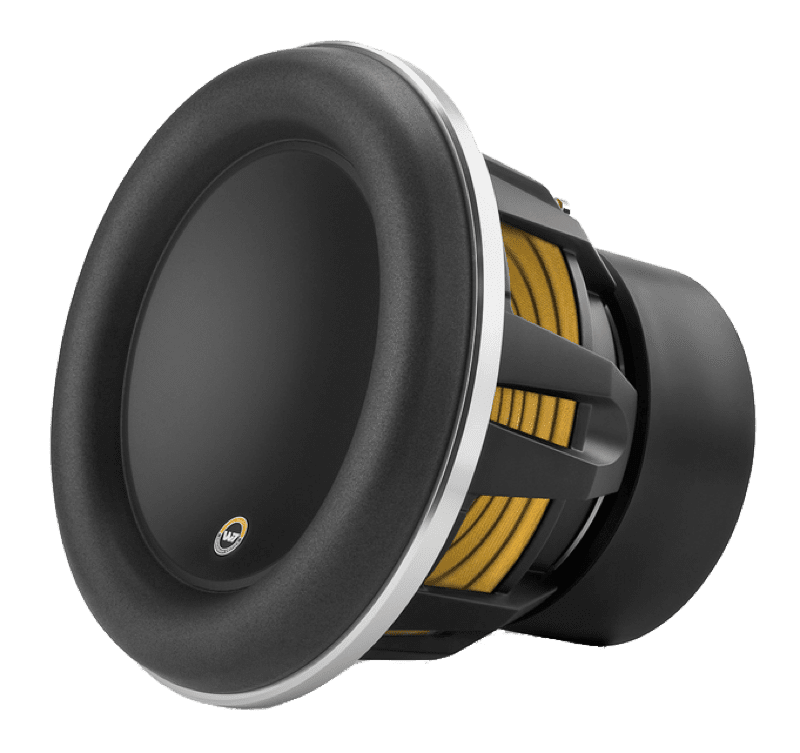
Speakers Different SizesMost subwoofers are sized from 8 to 18 inches. Since subwoofers are designed to play frequencies below 100 Hz in car audio applications, they need a lot of excursion capability and a low resonant frequency. This means subwoofers will have relatively heavy cones. At high excursion levels, cones are exposed to significant stresses, so the cone has to be strong, and this further contributes to their weight. Subwoofers have to handle a lot of power. This power allows us to move the cone over relatively large distances. Power handling requires bigger components in the form of large-diameter voice-coil formers and windings.

Midbass Drivers

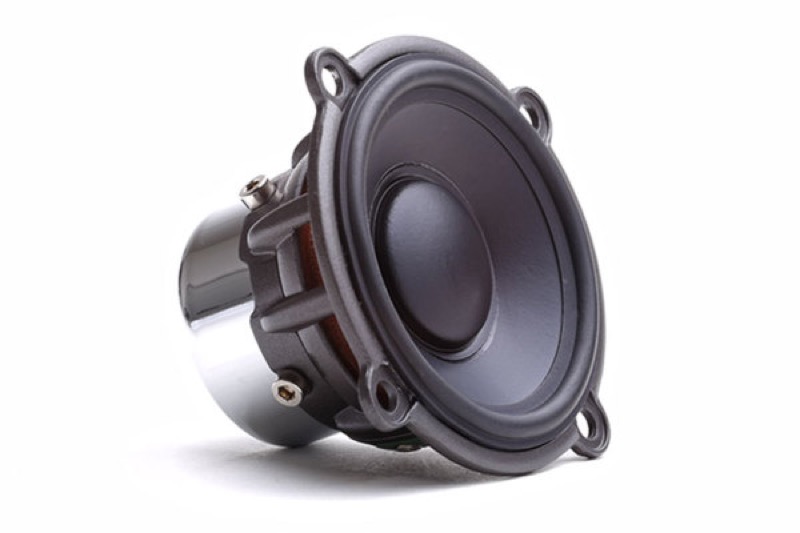
Speakers Different SizesA dedicated midbass driver is typically designed to play from around 50 to 500 Hz. Sizes are typically 6.5 to 8 inches in size, but some people have used 10- and 12-inch drivers. The cone has to be heavier than that of a midrange, but not heavy enough to slow it down for higher frequencies.

If you look at the frequency content of a performer, you will see that many voices extend down to 100 Hz. Accuracy in speed is important in this frequency range. Resonances and non-linear behavior causes harmonic distortion. This is often perceived as “warmth” in the midbass region. We do not want anything extra in our music, so accuracy is what matters.

Midrange Speakers

Speakers Different SizesMidrange speakers become a balancing act of several different characteristics. Of course, the cone has to be relatively light, but managing linearity and distortion becomes an even higher priority. It’s easier to hear distortion at midrange frequencies. The cone has to balance mass, damping and strength to prevent deforming and cause harmonics. The suspension has to be very linear.

Managing inductance also becomes a more significant issue because it can reduce high frequency output. Midrange drivers for typical car audio applications vary in size from 6.5 inches and 6×9 inches on the large side down to as small as 2.5 inches. Many midrange drivers try to do double-duty as midbass drivers for use in two- or three-way audio systems. While this is a minor compromise, it is a necessity. We consider midrange speakers to cover the range from 100 Hz to 3,000 or 4,000 Hz.

Tweeters

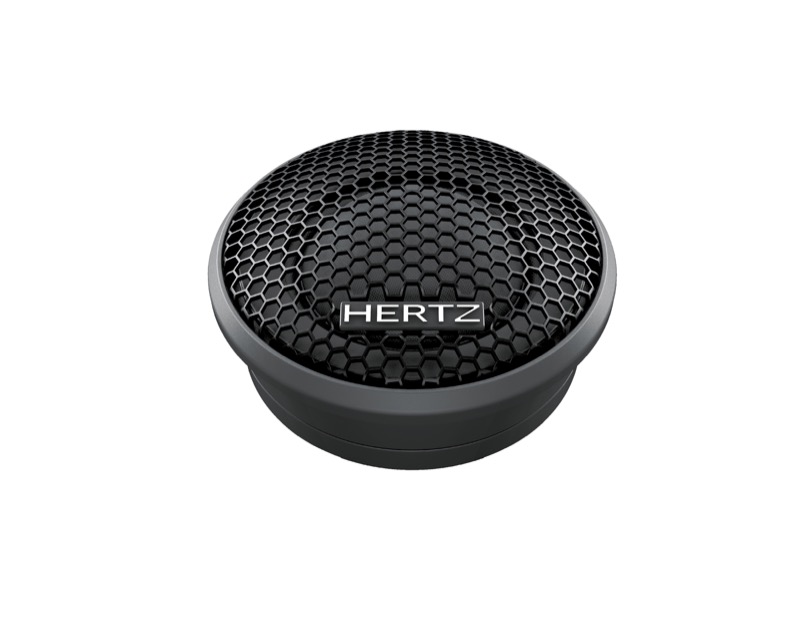
Speakers Different SizesTo reproduce frequencies above 2.5 kHz, tweeters need very light cones. Tweeter cones don’t move very far, so they don’t require much excursion, but there still has to be a suspension. Resonances in the cone can wreak havoc with frequency response. Premium tweeters may make use of features like ferrofluid in the gap to improve power handling. Premium tweeters may also include a copper pole-piece cap to reduce inductance and distortion.

Directivity Considerations

Another consideration when choosing speakers is that all speakers above a certain frequency start to become directional. Directivity refers to a reduction in high-frequency output as you move off-axis to the speaker. If you choose your speakers and design your system carefully, you can minimize the effect of directivity. The only real consideration would be to have your tweeters pointed at you.

The Balancing Act

The applications for the information in this article vary, depending on your overall goal for your audio system upgrade. A simple set of coaxial replacement speakers will be chosen by the size application. If you are building a high-end audio system with multiple amplifiers, channels, digital signal processing and custom speaker mounting locations, then choosing the right speakers in terms of their quality and intended application becomes more important.

Learn More about Speakers and Their Different Sizes at Your Local Retailer

Your local mobile electronics specialist retailer can help you choose the right speakers for your application and performance goals. Drop in at a local shop today and have a listen to their demo board or demo vehicle. It’s an amazing experience!

This article is written and produced by the team at www.BestCarAudio.com. Reproduction or use of any kind is prohibited without the express written permission of 1sixty8 media.
Filed Under: ARTICLES, Car Audio, RESOURCE LIBRARY

Product Spotlight: AudioControl A600.4

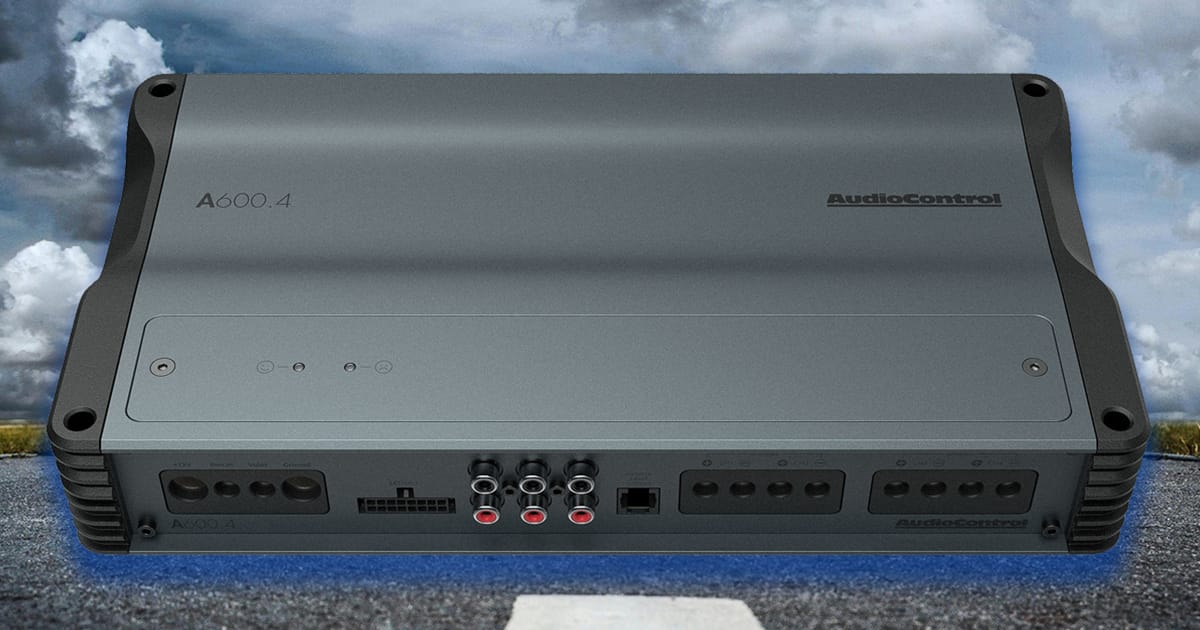
AudioControl A600.4

If you have been around the car audio industry for as long as we have, then you have likely used an audio processor in your vehicle. This veteran company is recognized worldwide for its line output converters, equalizers and crossovers. A few decades later, the brand has introduced several series of amplifiers. Their latest offering is the Altitude Series. In this spotlight, we’ll check out the four-channel A600.4 amp.

AudioControl A600.4 Specifications and Features

The A600.4 four-channel amp is rated to produce 100 watts of power per channel when driving four-ohm loads. That output increases to 150 watts per channel when driving two-ohm loads. When each pair of channels is bridged to a four-ohm load, the amp produces 300 watts of power.

With respect to performance, the amp has a THD+N specification of <0.21% and a signal-to-noise ratio of 107 dBA referenced to full power.

Let’s start with a unique feature included in the A600.4 – Valet mode. When a 12-volt signal is applied to the Valet input, the maximum power the amp can produce is reduced to 25% of its maximum output. The malfunction indicator LED will illuminate orange when the amp is in Valet mode. If you are concerned about someone abusing your car audio system, this feature is perfect for keeping your speakers safe.

The A600.4 is also equipped with AudioControl’s Great Turn-On (GTO) circuit. The amp can be activated by applying 12 volts to the remote input. Alternatively, when in GTO mode, the amp will detect the ~6-volt bias on the speaker wires of a factory-installed or aftermarket radio. If your installer is integrating the amp into a vehicle with a full-bridge amplifier, Audio mode will monitor the inputs for the presence of an audio signal to wake the amp up.

Another unique feature of the A600.4 is its use of Linkwitz-Riley alignments on the crossovers. While the slopes are still shallow at 12 dB / Octave, they will sum smoothly around the crossover point because the signal will be -6 dB at the knee frequency. Butterworth crossovers are only at -3 dB at the crossover point, which results in a 3 dB bump when the acoustic signals sum. In short, your system will sound better and have improved clarity around the crossover frequency with this design.

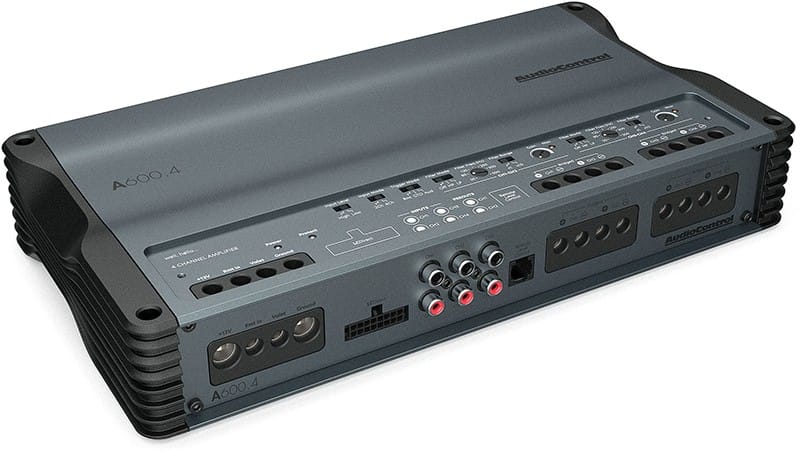
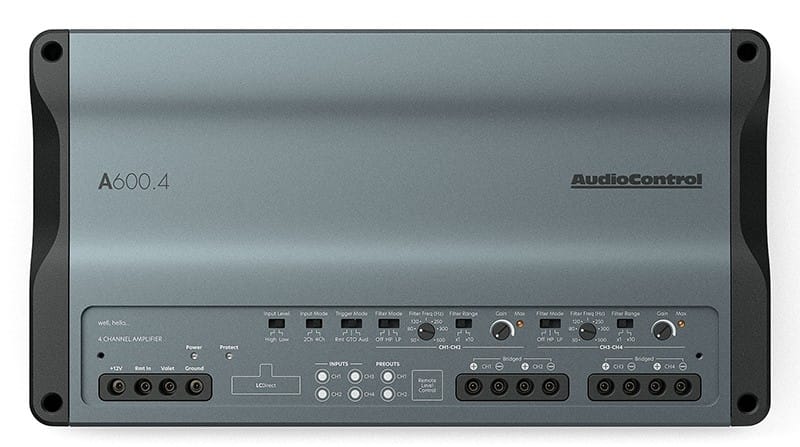
The amplifier is based on an aluminum extrusion and features uniquely styled end-caps for a clean appearance. A removable panel on top of the amp conceals all the signal adjustments and the set screws for the power and speaker connections.

All connections are made along the front edge of the amp using high-quality terminal blocks for 4-AWG power and ground, and 12-AWG speaker wire connections.

AudioControl A600.4
All connections are made along the front edge of the amp for a tidy installation.

Signal Processing Information

Each pair of channels has a sensitivity control that is adjustable from 0.5 to 6 volts on the RCA inputs and 1.5 to 20 volts on the speaker-level inputs. The speaker inputs are on an eight-pin Molex plug, and AudioControl calls this the LC Direct connection. The amp has a two or four-channel input switch. In two-channel mode, the signal on channel 1 (LC Direct or RCA) is copied to channel 3, and the signal on channel 2 is copied to channel 4. This is ideal if you are connecting that amp to something like a Bluetooth streaming device as a signal source. Each pair of channels has a Max input indicator. This LED will illuminate when the input is maximized and should flash occasionally when playing music recorded at high volume levels.

AudioControl A600.4
The A600.4 has clean lines and a modern aesthetic. It’s also small enough to fit under the seat of most vehicles.

The crossover on each pair of channels is adjustable between 50 and 500 Hz, or when the x10 switch is enabled, 500 to 5 kHz. This is enough range to handle subwoofer to midrange speakers, or midrange to tweeters. The crossovers on both channel pairs can operate in high- or low-pass mode to ensure maximum system design flexibility.

The amp has an RCA output terminal that can be used to feed an audio signal to an additional amplifier like the A800.1 800-watt monoblock to power a subwoofer.

Finally, there is a connection for an optional ACR-1 remote level control. When connected, you can adjust the output level of channels 3 and 4 to suit your mood or the music you’ve chosen.

AudioControl A600.4
Controls and set screws for the terminals are concealed behind a removable panel on top of the amplifier.

Upgrade Your Car Audio System with AudioControl

If you are shopping for a well-equipped four-channel amplifier to enhance your car audio system, drop by a local authorized AudioControl retailer and ask about the new Altitude Series A600.4. You can find a dealer near you using the locator tool on the AudioControl website.

Be sure to follow AudioControl on Facebook, Instagram and YouTube to stay up to speed with all their new products and solutions.

This article is written and produced by the team at www.BestCarAudio.com. Reproduction or use of any kind is prohibited without the express written permission of 1sixty8 media.
Filed Under: ARTICLES, Car Audio, PRODUCTS, RESOURCE LIBRARY Tagged With: AudioControl

Why Buy A Bigger Amplifier?

AmplifierWhen an audio enthusiast goes shopping for an amplifier, the question of “how much power do I need?” comes up almost every time. There are a few factors to take into consideration when answering this question. This article looks at those factors and provides some technical background to help support your decision.

Why Do We Need Power?

AmplifierQuite simply, when you send more power to a speaker, it moves farther and produces more output. Two limiting factors within the speaker itself control how much power it can handle. At higher frequencies, the limit is heat. Speakers are notoriously inefficient. The best convert about 2% of the energy sent to them into sound and the rest is converted to heat. When you send 60 watts of power to a speaker, most of that energy heats up the voice coil and the components around it. Eventually, those components will reach a temperature where they will fail. The speaker will usually stop working at this point, or shortly after.

The second limiting factor is how far the speaker can move. Inexpensive midrange speakers may be able to move back and forth about half an inch without creating massive distortion. Higher-end speakers have as much as twice as much cone excursion capability. (Speakers don’t sound the same at high volumes as they do at low. Audition your speakers at the volume you will be using them.)

Power vs. Output

Power works like this: When you double the power going to a speaker, the output increases by 3 dB. That is not a large amount. In fact, it is the smallest change in amplitude that is perceivable across the audible frequency range. (1 dB is the smallest perceivable change in amplitude where our hearing is most sensitive – 1 to 2 kHz).

Perceived volume is a different beast. An increase of 10 times the power sent to a speaker produces a doubling of perceived volume.

Speaker Efficiency

Another consideration in choosing an amplifier is the efficiency of your speakers. An inexpensive conventional midrange speaker may produce an average output of 91 dB when measured 1 meter away from the speaker cone and when driven with 1 watt of power. A high-quality speaker will likely be less efficient, but capable of playing over a wide range of frequencies. A measurement of 85 dB efficiency at the same distance and power level is not uncommon.

How Loud Do We Need it?

AmplifierA typical RMS sound pressure level for an orchestra, when you’re seated three or four rows back from the musicians, is around 100 dB. If we use our analogy of the 85 dB efficient speaker, we need 31.6 watts to get that speaker to play 100 dB. The problem is that this is the average power, not the peak power. Perhaps the performance crests at 110 dB? In that case, we need a peak power level of 316 watts. Just keep in mind that the speaker components are likely to melt if you keep this effort up for any significant amount of time.

We don’t suggest buying any speaker based on its efficiency. Criteria like linearity, lack of distortion, application limitations and frequency range are far more important. If you need it loud, buy more speakers, or larger speakers.

Distortion Happens

What happens if we run out of power in an amplifier? We get distortion. This distortion creates all sorts of high-frequency harmonic content. That increased high-frequency energy is what causes tweeters to fail. We need to choose an amplifier that will allow our speakers to play loudly enough without running out of power.

You are better off buying a 100 watt per channel amplifier and only using 50 watts than you are buying a 50 watt amplifier and occasionally causing it to distort. Remember, those 50 extra watts only result in an increase in output of 3 dB – assuming the speaker can handle it.

It Takes Power to Make Power

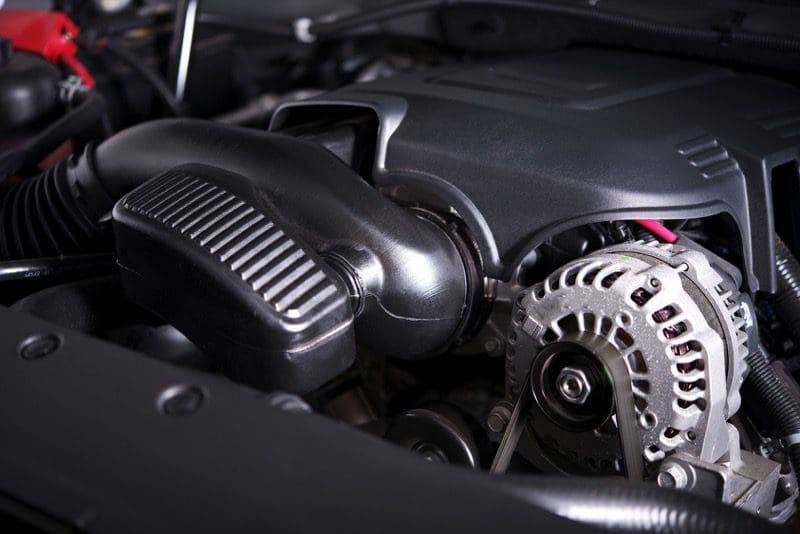
AmplifierA consideration that many people overlook is the ability to supply an amplifier with the power it needs to produce the power you want. Modern vehicles have electrical systems with reduced power production capabilities. Smaller alternators, smaller batteries and smaller wiring save weight. Reduced weight transforms into better fuel economy for the vehicle.

As a general rule of thumb for power consumption calculations, you can assume that every 100 watts of power from an amplifier will require about 10 amps of current from your electrical system. Yes, some amplifiers are more efficient than others, but this serves as a good, quick guideline.

If you want to purchase a 650 watt amplifier to power your subwoofer, then your electrical system (battery and alternator) has to be able to provide it with about 65 amps of current. This power requirement is on top of what is required to run the vehicle. The computers, lights, ignition system, radio and heater all consume power as well. On a modern compact car, it would be no surprise if you only had 30 to 40 amps of power left over for an amplifier.

You can get away with a big amplifier – but you can’t play it indefinitely, even with the vehicle running. Once you have exceeded the power delivery capabilities of the amplifier, the battery will start to supply current. You can kill a car battery, even with the vehicle running. Once you shut the car off, you may not have enough energy in the battery to restart it.

Blowing up Amplifiers

AmplifierAmplifiers do not like to be starved for power. When you run out of power to drive your amplifier, in most cases, the amplifier rail voltage starts to drop. Power starvation causes the maximum undistorted power production of the amplifier to decrease. We are back to the same scenario: Distortion causes harmonics, and harmonics can damage fragile speakers.

If you have had an amplifier fail, and the failure was because the power supply section of the amp self-destructed, chances are you were not able to feed the amp properly.

How Much Amplifier Power Do You Need?

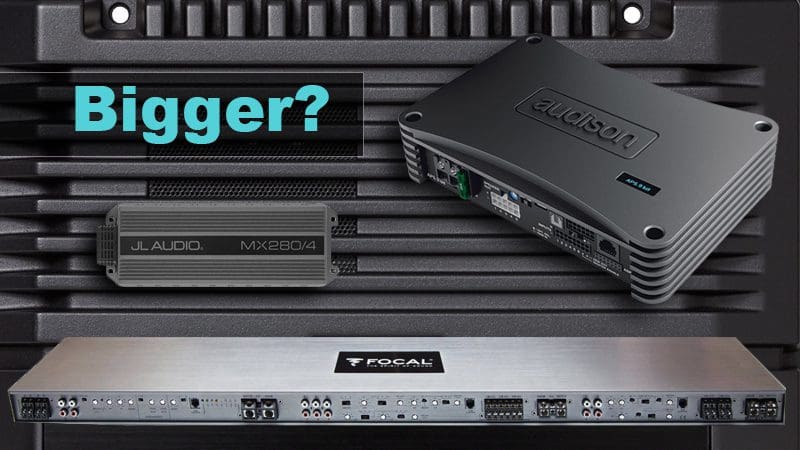
The solution: Buy as much as power as you can afford. Buy the biggest that will physically fit in your application. Get the highest-performance amplifier you can. Make sure your installer uses properly sized wiring to install the amplifier. Upgrade your car battery to a high-performance, high-capacity unit if you need more reserve power.

For more information, visit your local mobile electronics specialist retailer. Be honest about your needs and expectations for your audio system. They will be able to suggest a solution that sounds fantastic and will offer years of reliable performance.

This article is written and produced by the team at www.BestCarAudio.com. Reproduction or use of any kind is prohibited without the express written permission of 1sixty8 media.
Filed Under: ARTICLES, Car Audio, RESOURCE LIBRARY

  • « Previous Page
  • 1
  • 2
  • 3
  • 4
  • …
  • 11
  • Next Page »

Recent Articles

The JL Audio AP6006

Product Spotlight: JL Audio AP600/6

February 16, 2026 

A few decades ago, amplifiers designed for marine applications were not only huge but also inefficient and, crucially, not truly waterproof. Things have come a long way since then, … [Read More...]

ADS iDatalink Maestro APX Kits

Product Spotlight: ADS iDatalink Maestro APX Kits

February 2, 2026 

In February of 2025, Automotive Data Solutions (ADS) introduced the world to a new way of installing car radios. In their presentation, they discussed how aftermarket source unit … [Read More...]

A boy covered in grease with a shocked look on his face holding 4 cables while smoke rises behind him on a blue background

Does Preamp Voltage Matter?

February 1, 2026 

For almost as long as there have been car audio enthusiasts, they have been adding amplifiers to their vehicles to increase the power available to drive their speakers. More power … [Read More...]

Product Spotlight: Rockford Fosgate P2V2-65

Product Spotlight: Rockford Fosgate P2V2-65

January 5, 2026 

Rockford Fosgate revamped its entire Punch Series speaker lineup and launched it at SEMA 2025. Rather than the good, better, best arrangement of previous years, they’ve created … [Read More...]

Rear Speakers

Rear Speakers – A Benefit or a Bad Habit?

January 4, 2026 

For decades, automobile manufacturers have installed relatively large rear speakers in their vehicles. The stereotype of a set of 6x9 speakers sitting on the parcel shelf of a … [Read More...]

Subscribe!

Enter your email address to subscribe to our website and receive notifications of new posts by email.

Join 8 other subscribers

Testimonials

Nice staff and honor their work

Audio Crew did some work for me about 2yrs ago. A speaker they installed wasn't working properly. They checked it out and problem was a corroded wire. They fixed the problem and told me no charge for the repair. Very nice of them to do that as problem wasn't their fault in the first place. Audio Crew have a nice staff and honor their work.

VERY HONEST and PROFESSIONAL company

I purchased a 2019 used car for my wife and she wanted a remote started installed. I went to Audio Crew, who I had dealt with before, got a price and made an appointment. We dropped the car off the night before, for the appointment with a request that they call us when ready. Early the next morning, I received a call telling me that there was good news!! The car already had a remote starter which was programmed into the factory remote. We only need to press the "lock" button three times to star the car!! The dealer who sold us the car was not aware of that, it was a pleasant surprise to us and a $350 savings. THANK YOU to a VERY HONEST and PROFESSIONAL company.

Absolutely the best service

Absolutely the best service you will get anywhere. They go above and beyond! Can’t recommend them more! They fixed our issue quickly. Super friendly and helpful. Will not buy anywhere else.

Great Service

Great service, huge demo room with great prices. Very knowledgeable and professional service from the owner and will work within your budget to help you achieve your goals in the sound system your looking for. Extremely great experience dealing with them, also pricing was excellent competitive prices.

Subscribe to Our Website

Enter your email address to subscribe to our website and receive notifications of new posts by email.

Location


Get Directions to Audio Crew

Address

Audio Crew

624 Salisbury Rd
Moncton, NB E1E 1B8
506-858-2739

Connect With Us

  • Facebook
  • Instagram

Services

  • Car Audio
  • Marine Audio
  • Motorcycle Audio
  • Remote Starters
  • UTV and Side-by-Side Upgrades

Store Hours

Monday, Tuesday, Wednesday, Thursday, Friday8:30 am – 5:00 pm

Copyright © 2026 Audio Crew · Privacy Policy · Website by 1sixty8 media · Log in


Loading Comments...